Exercise stress test
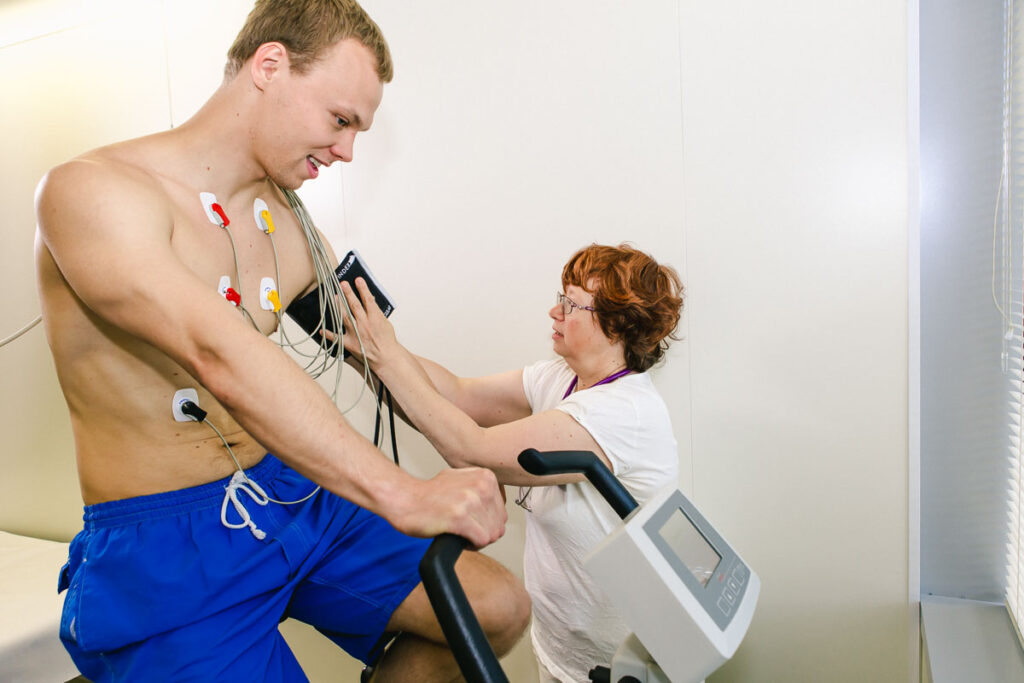
An electrocardiographic exercise test (exercise ECG test) helps assess overall health status. During physical exertion, it allows evaluation of cardiovascular functional performance and the detection of abnormalities that may not be apparent at rest.
Why undergo an exercise ECG test?
The test provides an overview of cardiac function during exercise and recovery.
It allows assessment of blood pressure changes during exercise and evaluation of recovery after the test.
The test gives an overview of exercise tolerance, i.e. physical fitness.
For recreational athletes, it provides important information for safer and more effective training management.
It enables determination of individual heart rate zones as well as aerobic and anaerobic thresholds.
What is an exercise ECG test?
Health status assessment – electrocardiography (ECG) both at rest and during exercise, and measurement of arterial blood pressure.
Electrocardiography (ECG) describes the electrical activity of the heart. To record an ECG, electrodes are attached to the patient’s chest and limbs. ECG allows assessment of heart rhythm and detection of arrhythmias if they occur during the recording, abnormalities related to myocardial ischemia, disturbances in the cardiac conduction system (blocks), and changes indicative of heart disease (for example, atrial or ventricular pathology caused by valve disorders, or changes related to myocardial hypertrophy), among others.
If a patient experiences symptoms suggestive of heart disease during physical exertion (such as chest pain or shortness of breath), an exercise stress test (performed on a bicycle ergometer or treadmill) is conducted, and the ECG is recorded during and after exercise. In many cases, heart disease–related changes are not detectable on a resting ECG but become evident during exercise.
Measurement of arterial blood pressure is an integral part of cardiovascular assessment. Blood pressure is usually measured on the upper arm in a seated position using a mercury sphygmomanometer, an aneroid device, or a semi-automatic electronic monitor. In adults, blood pressure is considered elevated if it exceeds 140/90 mmHg when measured during a physician’s visit, or 135/85 mmHg when measured at home. If necessary, blood pressure may also be measured in the legs (with the cuff placed on the thigh).
Health examinations offered by Terviseuuringud.ee that include an exercise ECG test:
Recreational Athlete Plus
Cardiac Package Plus
It is also possible to add an exercise ECG test to the Health Assessment at a discounted price – €90.